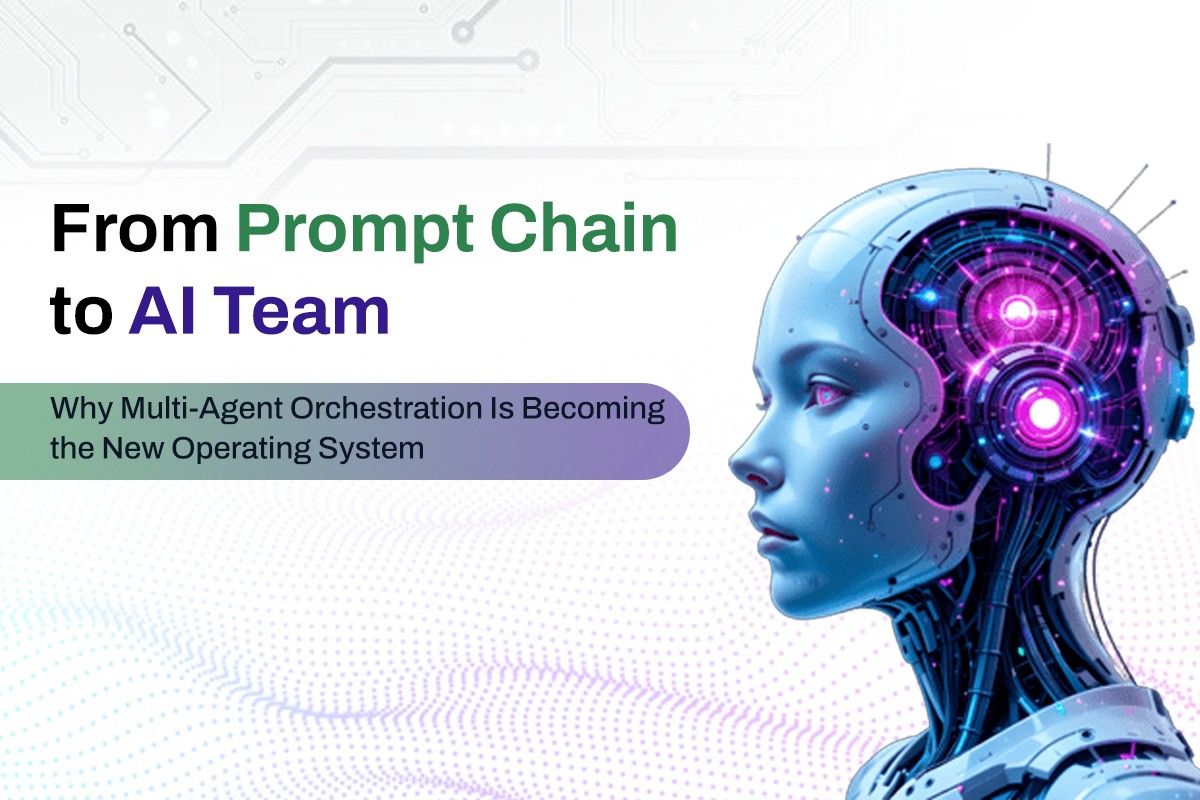
From Prompt Chain to AI Team: Why Multi-Agent Orchestration Is Becoming the New Operating System
Souvik Karmakar
13th May 2026
The End of Single-Agent AI
For a while, one AI assistant felt impressive enough. You gave it a task, and it gave you a result. That felt efficient. But that single-agent model is already starting to feel outdated and limited. We are now moving into the age of multi-agent orchestration. In this new approach, one system no longer works completely alone. Instead, multiple specialized agents now step in to coordinate with each other. They collaborate closely and complete entire workflows as a unified team.
AI is no longer just answering requests. It is beginning to operate like a real digital team.
How AI Teams Actually Work
The real breakthrough is not just intelligence. It is coordination. Modern systems built around autonomous digital workers are designed to split large tasks into smaller moving parts and assign each part to the right agent.
Here is how these systems typically function:
- The Coordinator: One lead agent interprets the objective and decides how the task should be divided.
- The Specialist: Separate agents handle research, content, coding, analysis, or planning based on their assigned roles.
- The Reviewer: Another layer checks the work, flags weak outputs, and routes the task back for correction.
This is exactly why AI enterprise workflows are starting to look less like automation scripts and more like full operational systems.
Why This Changes Business Execution
Single-threaded work slows teams down. Multi-agent systems remove that bottleneck. Instead of waiting for one assistant to finish one step before beginning the next, businesses can now run multiple processes at the same time.
That changes everything for modern operators. Strategy can be researched while copy is drafted. Reports can be analyzed while campaigns are planned. Internal knowledge can be organized while outbound messaging is tested. This is why multi-agent orchestration is quickly becoming a serious competitive advantage. It does not just save time. It changes how time is used.
What This Means for Founders and Operators
This shift matters most to fast-moving teams.
- For SaaS founders: Product feedback can run smoothly on one track. Competitor tracking can operate at the same time on another. Customer support logic can handle its tasks in parallel, too. All these processes now work together without slowing each other down.
- For agencies: Content production can flow smoothly on its own track. Performance reporting can be updated in real time alongside it. Campaign ideation can spark ideas without any delays. All these tasks now happen together, without needing constant manual switching between them.
- For operations teams: Repetitive internal processes can be delegated to autonomous digital workers that keep improving with feedback.
The teams that learn to manage AI systems like departments will move faster than the ones still treating AI like a one-window chatbot.
Build for the New Workflow Standard
The old question was, “How can AI help me with this task?” The new question is, “How should these agents work together without me?” That difference is massive. The companies that redesign around AI enterprise workflows will gain speed, consistency, and scale. The ones that keep relying on one-off prompting will keep losing momentum. The future does not belong to isolated tools. It belongs to orchestrated intelligence.
Disclaimer: This blog discusses emerging AI workflow strategies and operational concepts. Real-world multi-agent performance depends heavily on model quality, orchestration design, security controls, and human supervision.
Views (285)
Comments (0)
Duration (0)


.jpeg)


 Facebook
 Instagram
 WhatsApp
 Linked in
 Twitter
 Reddit
Comments (0)
Write a Comment