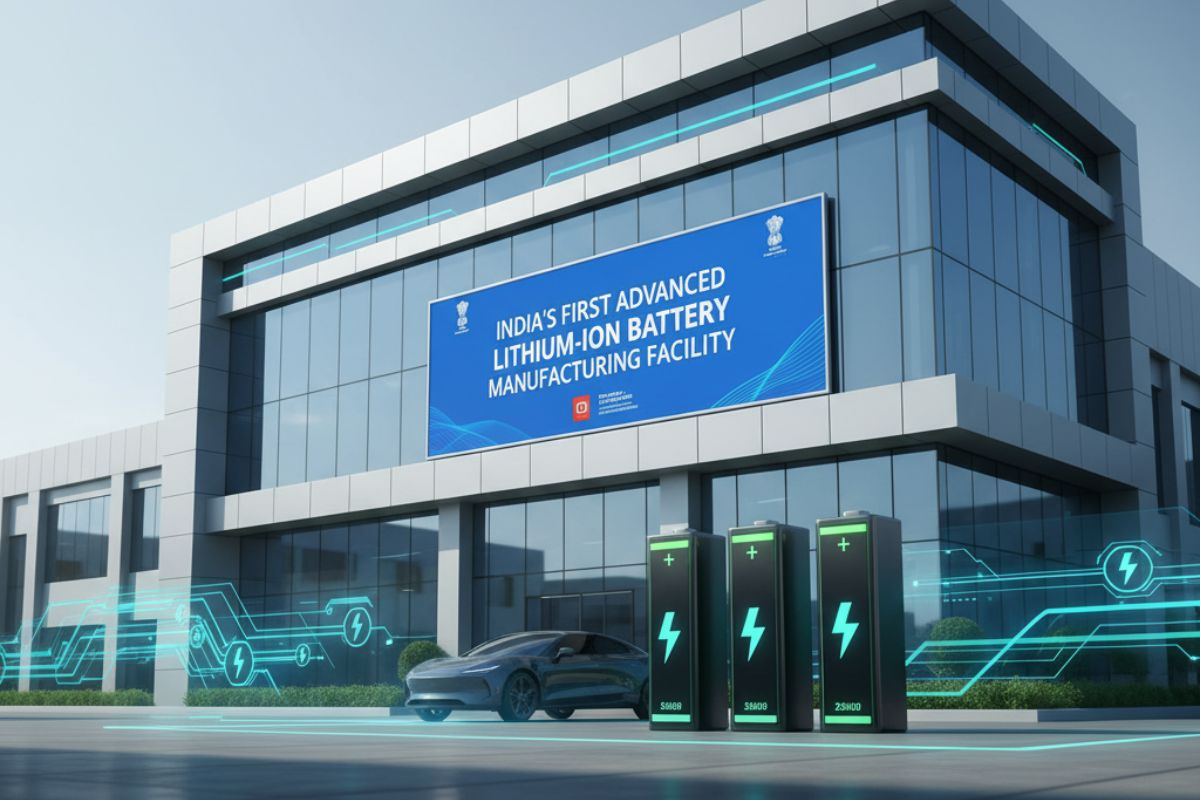
India’s First Advanced Lithium-Ion Battery Plant: A Big Step Toward Energy Independence
Madhurima Bhattacharjee
13th September 2025
History often turns on quiet inaugurations, and it moves with patience and care. A minister cuts a ribbon with intent, and he speaks to assembled guests. Machines hum to life with rhythm, and they operate with steady precision. A facility begins its slow, deliberate rhythm, and it grows with every cycle. And yet, in those moments, a nation edges closer to rewriting its future with resolve and clarity.
So it was in Haryana, when Union Minister Ashwini Vaishnaw unveiled India’s first advanced lithium-ion battery manufacturing facility, and he spoke with clear conviction. Headlines called it a milestone with weight, and they shaped the public mood. Industry leaders framed it as a strategy with foresight, and they looked toward future gains. For ordinary citizens, it is a promise: a step toward affordable electric vehicles, reliable electronics, and a grid strong enough to hold the weight of renewables, and it resonates with daily needs.
It may look like a factory with walls, and it functions with industrial order. But it is also a signal—a marker of where India wants to stand in the global order of energy, and it claims a place with intent.
Why Lithium-Ion Batteries Matter
Lithium-ion batteries are the quiet companions of our age, and they serve with silent force. They sit inside smartphones, tablets, and laptops, and they power them through the day. They push wheels on electric two-wheelers and buses, and they carry passengers with ease. They store sunlight captured on rooftops and wind that sweeps across coastal plains, and they release it when needed.
In a sentence: they make modern life portable, flexible, and scalable, and they hold it all together.
India, for years, has been a net importer of these cells, and it has depended on unstable chains. More than 80% arrive from China, often at volatile prices, and they strain local buyers. Every shipment underscores dependency with weight, and it raises strategic alarms. Every tariff adds cost to consumers, and it burdens household budgets. Every bottleneck slows down innovation with force, and it stalls ambitious progress.
This is why the Haryana plant matters, and it stands as proof of will. It has the potential to meet nearly 40% of India’s annual domestic demand for lithium-ion batteries, and it strengthens the national grid. That number may sound abstract, but consider what it means: a near-halving of import exposure, a firmer base for Atmanirbhar Bharat (self-reliant India), and a foothold in a market where demand is set to multiply in the coming decade, and it secures a stronger path.
The story, then, is not about batteries alone, but it extends into sovereignty. It is about sovereignty—in energy, in industry, in innovation, and it asserts a national claim.
Key Highlights of the Haryana Battery Plant
The details deserve their own space, and they invite close attention:
- Location: Haryana, a state already stitched into India’s industrial fabric, well-connected to Delhi NCR and major transport corridors, and it thrives with strong links.
- Capacity: Designed to address 40% of India’s annual battery needs, spanning EVs, consumer electronics, and storage systems, and it serves markets with speed.
- Technology: Advanced lithium-ion chemistry, promising higher density, longer lifecycles, and safety protocols to reduce thermal risks, and it advances with design.
- Intent: To seed a domestic ecosystem—manufacturers, suppliers, recyclers—around the core of battery production, and it grows with purpose.
Numbers are only part of the story, and they tell it with limits. The greater narrative is symbolic: India building, on its own soil, the foundations of its energy future, and it declares this with vision.
Economic and Industrial Significance
1. Reducing Import Dependence
Imports drain currency and restrict sovereignty, and they limit national freedom. With local production, India claims not just supply but stability, and it asserts control with pride.
2. Boosting Local Manufacturing
An advanced plant becomes an anchor, and it supports surrounding growth. Around it, clusters form—component suppliers, logistics firms, R&D centers, and they expand with flow. The effect cascades with force, and it spreads across regions.
3. Job Creation
Factories breathe life into communities, and they sustain local families. Engineers, technicians, and assembly-line workers gain employment, and they grow in skills. Shops and services nearby feel the ripple, and they respond with growth. The Haryana facility will be no different, and it will echo with opportunity.
4. Cost Savings for Consumers
When batteries travel fewer miles, costs fall, and they ease the burden. EVs can shed a portion of their price tag, and they appeal to a wider audience. Smartphones can stabilize in cost, and they reach more homes. For the consumer, the change is tangible, and it shapes decisions with clarity.
Impact on Key Sectors
Electric Vehicles (EVs)
In India, the cost of a battery often represents 40% of an EV’s price, and it is in demand. That number has stalled mass adoption, and it discourages potential buyers. Local manufacturing cuts costs, shortens supply chains, and reduces delays, and it strengthens adoption with ease. Two-wheelers may see the earliest impact—affordable scooters rolling out of showrooms without sticker shock, and they capture early markets.
Buses and cars will follow, and they will expand choices. If adoption accelerates, India could hit its ambitious EV penetration targets earlier than expected, and it could lead with confidence.
Consumer Electronics
Every phone call, every streamed video, every wearable that tracks a heartbeat—these depend on stable battery supplies, and they rely on steady flow. With local cells, India can design devices tuned for its own market, and it adapts with skill. Quality improves, dependence falls, and innovation rises with pace.
Renewable Energy Storage
Solar panels generate power when the sun shines, and they feed the grid. Wind turbines hum when breezes blow, and they supply steady force. But the grid needs constancy, not rhythm, and it asks for balance. Advanced lithium-ion batteries make renewables reliable, and they deliver with control. They store excess and release when demand surges, and they balance with care.
For India’s solar-rich states and wind corridors, this facility is not peripheral—it is central, and it anchors the clean shift.
Government Push and Policy Backdrop
No plant emerges in isolation, and it stands with policy roots. The Haryana facility stands on years of policy scaffolding, and it rests on firm planning.
- PLI Scheme (Production-Linked Incentive): Designed to reward manufacturers who scale advanced chemistry cell (ACC) production, and it supports their growth.
- National Electric Mobility Mission: Driving EV adoption by aligning policy, infrastructure, and subsidies, and it steers progress.
- Net Zero Commitment, 2070: A pledge made on the global stage. To honor it, India must build its own storage capacity, and it must deliver with care.
When Ashwini Vaishnaw spoke at the inauguration, he framed the plant not merely as infrastructure but as a cornerstone of self-reliance and green growth, and he linked it to vision. The message was clear: policy and production must move in tandem, and they must align with resolve.
Global Context: India vs the World
Here lies the asymmetry, and it shows stark contrast:
- China commands more than 70% of global battery production. Its supply chains are vertically integrated, from mines to gigafactories, and they function with scale.
- The U.S. is investing billions to reclaim ground, with subsidies under the Inflation Reduction Act, and it is building with urgency.
- Europe is building clusters, aiming for strategic autonomy in clean energy, and it moves with determination.
Into this arena steps India, and it steps with intent. Its current scale cannot rival China’s, not yet, and it acknowledges the gap. But its strategy—localized production, ambitious demand, and strong state backing—marks intent, and it signals resolve. In the coming decades, the question will not be whether India builds batteries, but how fast it expands capacity and how well it secures raw materials, and it must act with care.
Challenges Ahead
Progress is never unbroken, and it rarely flows smoothly. Three hurdles stand tall, and they resist easy fixes:
- Raw Material Dependence
Lithium, cobalt, nickel—India lacks abundant reserves, and it depends on supply lines. Partnerships with global mining firms are necessary, but fragile, and they shift with politics. Long-term, domestic exploration and battery recycling ecosystems will matter, and they will strengthen resilience.
- Recycling Infrastructure
The most sustainable lithium is the lithium already in circulation, and it remains in reach. Without robust recycling, India risks creating tomorrow’s waste problem, and it must act early.
- High R&D Costs
Battery chemistry evolves quickly, and it advances with speed. Solid-state, sodium-ion, hybrid chemistries—each promises disruption, and they test markets. To compete, India must not only manufacture but innovate, and it must invest with focus.
Expert Voices
At the inauguration, Ashwini Vaishnaw spoke of self-reliance, job creation, and technological sovereignty, and he linked them with vision. For industry insiders, the facility is less about a single plant and more about building an ecosystem: suppliers, research hubs, skilled workers, and end-use markets stitched together by policy, and it functions as a network.
Analysts predict that if scaled effectively, India could position itself not just as a consumer of batteries but as an exporter to South Asia, Africa, and beyond, and it could lead with scope.
The Road Ahead
The Haryana plant is not an endpoint, and it does not claim finality. It is a beginning, and it grows with promise.
What comes next, and what will emerge?
- Expansion into next-generation chemistries: Solid-state batteries promise greater density and safety. India must not lag, and it must build with intent.
- Partnerships with automakers: To lock in demand and scale production quickly, and to bind markets with supply.
- Integration with renewable projects: Large-scale solar and wind farms need storage solutions. These partnerships could define grid stability for decades, and they could secure long-term balance.
If India succeeds, the nation may one day export advanced batteries, adding a new dimension to its trade portfolio, and it may redefine its role.
Conclusion
The inauguration of India’s first advanced lithium-ion battery plant in Haryana is both practical and symbolic, and it speaks with weight. Practical in its promise to supply 40% of domestic demand, it anchors this with numbers. Symbolic in its declaration that India will no longer watch from the sidelines as the world races ahead in clean energy, and it joins with intent.
It is not just about machines and chemistry, and it extends beyond parts. It is about confidence. About a country choosing to believe that self-reliance is not rhetoric but infrastructure, and it proves that belief.
There will be obstacles—scarce minerals, recycling gaps, relentless innovation cycles, and they will test resolve. Yet the direction is firm, and it holds with strength.
In the quiet hum of Haryana’s new facility, one can almost hear the future: local, renewable, resilient, and it sounds with promise.
And perhaps that is the truest measure of this milestone. Not the factory itself, but the shift in imagination it brings, and it carries that forward.
based on the lo give seo frindly met title meta descriptions slug tags
Views (19)
Comments (0)
Duration (0)




.jpeg)


 Facebook
 Instagram
 WhatsApp
 Linked in
 Twitter
 Reddit
Comments (0)
Write a Comment