India's New Space Era: Axiom-4 and the Dawn of Global Human Spaceflight
Uzma Khan
28th June 2025
On June 25, 2025, a rocket lifted from Florida’s coast.
It was early. The sky was still dark.
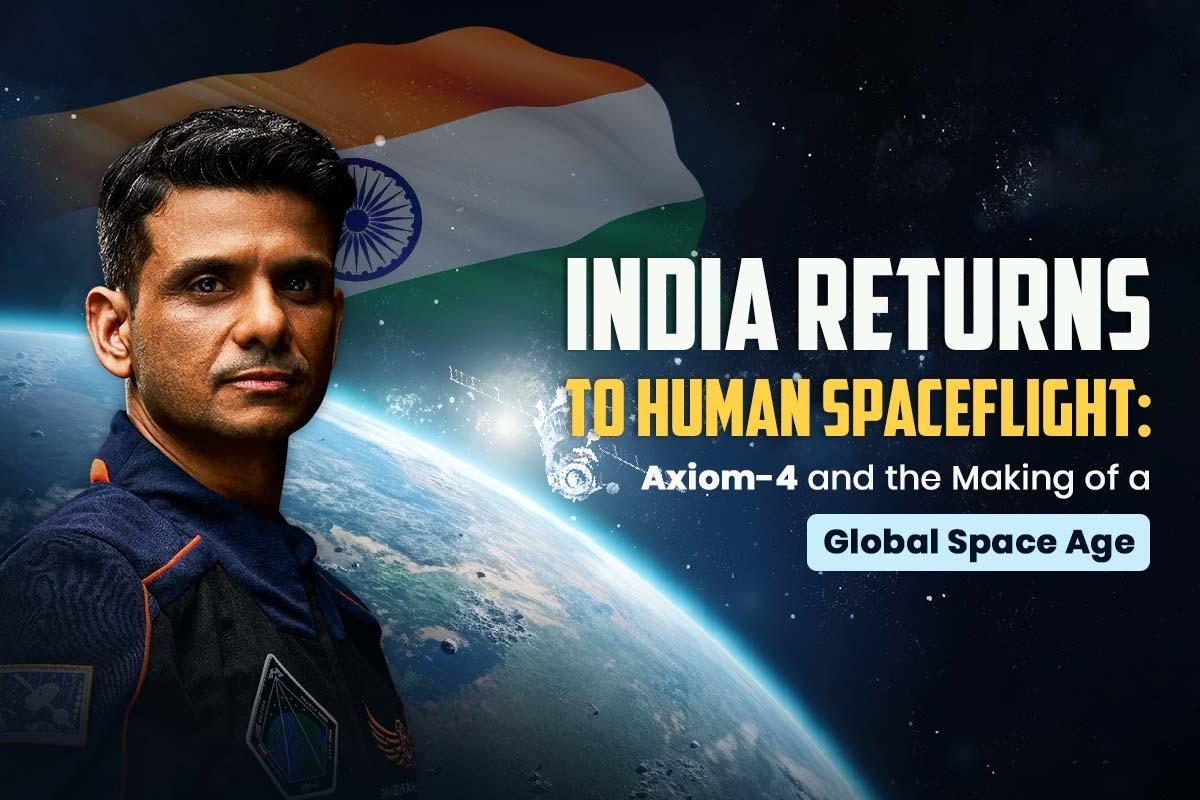
Inside the Dragon capsule, four astronauts sat. One of them—Group Captain Shubhanshu Shukla—carried a quiet milestone. He became the first Indian to reach the International Space Station (ISS). This was Axiom Mission 4, or Ax-4. A private mission, organized by Axiom Space, and flown aboard SpaceX hardware.
No ceremony. No bold declarations. Just the steady rhythm of launch, orbit, and docking. But history doesn’t always arrive with noise. Sometimes, it arrives with calm precision. And for India, this was a return. Not to the idea of space, but to the practice of being there.
The Long Arc Back
India last sent a human into space in 1984. Rakesh Sharma’s Soviet-backed mission became part of national memory. But since then, the silence has stretched long, technical, and unfinished.
Ax-4 changes that.
Shukla, a career pilot in the Indian Air Force, was not sent to plant flags or deliver messages. His mission is scientific. His training is grounded. He is part of ISRO’s human spaceflight program, but here, he works within a larger framework—international, commercial, and coordinated.
That, too, is new.
The Science They Carried
The Ax-4 crew will spend roughly two weeks aboard the ISS. In that time, they will conduct more than 60 experiments. Seven of those are Indian in origin.
They are not flashy. They do not aim to dazzle. But they ask necessary questions.
How do crops like fenugreek or green gram grow in microgravity? What happens to bacteria, to muscles, when Earth’s weight no longer applies? Can we trust medicine to hold its form on long journeys? Can the body adapt, not just survive, in orbit?
These are not questions of adventure. They are questions of endurance. Of continuity. They point not to the leap, but to the long stay.
A Different Kind of Participation
There’s something quietly radical about Axiom’s approach. This is not a government-led expedition. It’s a private mission, drawing in astronauts, researchers, and institutions from around the world. India did not build the rocket. It did not own the launch. Yet here it is—onboard, contributing, and present.
That matters.
It means a country can take part in orbital science without recreating every piece of infrastructure. It opens space to new actors—serious, prepared, and purposeful. Not tourists. Partners.
Shukla’s mission is proof of concept. A signal that India can carry its scientific agenda into space through collaboration. Through presence. Through work.
A Moment That Doesn’t Shout
When the Dragon Capsule docked with the ISS, there was no pageantry. Only a slow alignment. Then the hiss of pressure equalizing. And finally, the crew, floating one by one, into the station’s quiet light.
Shukla’s voice came through calmly: “Namaskar from space.”
There was no flourish. Just acknowledgment. The kind that comes from knowing the road to this moment was long. And that the real work still lies ahead.
What Lingers
The mission will last two weeks. The data may take months to analyze. But what it opens could last much longer.
India has returned to human spaceflight. Not in grand gestures, but in method. In science. In presence. The ISS, once a symbol of exclusivity, is becoming something more open—more reflective of the world watching below.
This is not space as spectacle. It is space as a shared laboratory. A shared future.
And from that quiet corner of the station, an Indian voice has joined the chorus. Not to claim, but to contribute.
Views (29)
Comments (0)
Duration (0)





.jpeg)


 Facebook
 Instagram
 WhatsApp
 Linked in
 Twitter
 Reddit
Comments (0)
Write a Comment