What the Red Sea cable outage means for India's cloud services and online business
Madhurima Bhattacharjee
12th September 2025
Introduction
The internet is not weightless, and it actually travels through hidden cables beneath oceans in silence. It hums beneath oceans, and it carries information from country to country every single second with ease. When these cables falter, and when they suddenly stop working, entire economies quiver, and people feel the slowdown clearly. The recent Red Sea cable outage proved this, and it showed how fragile the world’s digital systems really are today. What appeared as a distant event in maritime waters, and what looked like something far away, quickly bent the arc of India’s digital economy in full. Cloud services slowed, and the SaaS industry wavered, and online businesses held their breath in worry. This disruption was not only about speed, and it was about fragility, and about the quiet recognition that India’s digital future rests on infrastructure it does not fully control yet.
Background: The Red Sea Cable Outage
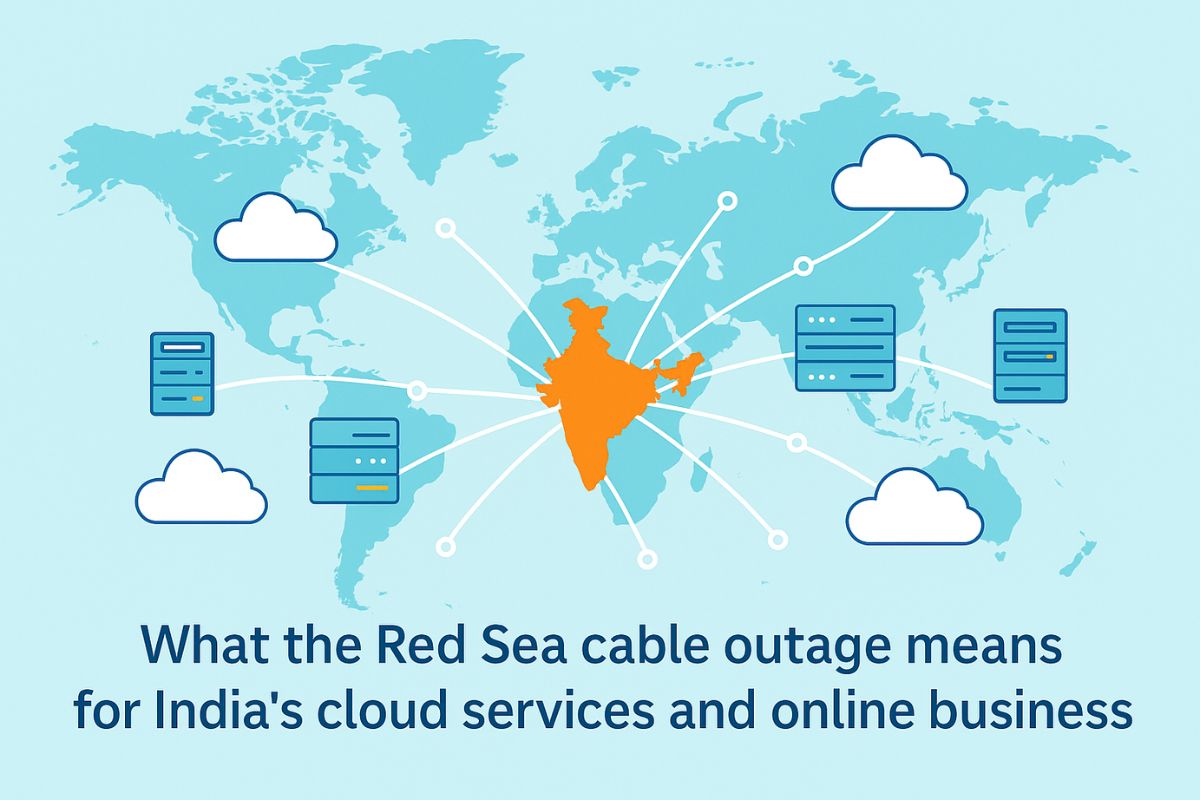
The Red Sea is more than geography, and it is a corridor for subsea cables, the arteries through which Asia, Africa, and Europe exchange their digital lifeblood every day. When several of these cables were cut, and when they suddenly stopped working, the world felt the ache deeply. India felt it most, and a large portion of its traffic to Europe and beyond flows through this passage strongly. With the outage, data was rerouted across longer paths, resulting in delays, loss of efficiency, and creation of noticeable disruptions everywhere. Every click, every query, every SaaS based application felt the drag instantly.
Immediate Impact on India
Slower Internet and Latency Issues
For ordinary users, the outage surfaced as something simple, and pages loaded more slowly, videos buffered longer, and calls glitched too often. But latency is not trivial, and for gamers, traders, or teams on video calls, the delay was not just irritation; it was interruption and disruption.
Stress on Data Centers and Cloud Providers
AWS, Azure, and GCP scrambled to rebalance, and their reliability depends on the health of these cables for smooth function. Workloads suffered, and a reminder is clear: cloud resilience has limits when the seabed fractures completely.
Online Businesses Felt the Pinch
E-commerce platforms counted lost carts, and fintech apps braced for failed transactions quickly. Streaming services logged rising churn, and startups in the SaaS industry, many without redundancy plans, felt exposed and vulnerable. The outage turned into a stress test, and it revealed cracks in the system.
Cloud Services Under Pressure
Cloud services thrive on invisibility, and you rarely notice them until something shakes the ground beneath you unexpectedly. Rerouting Traffic slowed performance, and every extra mile a packet travels compounds the delay for everyone. Higher Costs emerged as providers leaned on pricier routes, a burden that may trickle down to businesses dependent on cloud and SaaS integration as well. Reliability Risks cracked the veneer of guaranteed uptime, and five nines sound strong, until a ship’s anchor or seabed quake proves otherwise.
Impact on Indian Online Businesses
E-commerce Platforms
For platforms moving millions of orders daily, every extra second at checkout translates into lost trust and lost sales immediately.
Fintech and Payments
While UPI held steady for domestic payments, cross-border remittances faltered and slowed. The promise of instant faded into minutes, and for customers, patience has limits quickly.
Startups and SMEs
Smaller firms bore disproportionate pain, and startups building SaaS based applications, with no redundancy, faced outages they could not mask effectively. Many rely on leading SaaS companies for back-end integration, but dependency cuts both ways, and fragility showed itself clearly.
Media and Entertainment
Streaming platforms and gaming firms depend on immediacy, and buffering breaks immersion, lag undercuts competition, and customers notice every flaw. Customers notice, and once noticed, they rarely forget, and loyalty weakens slowly.
Long-Term Implications
The outage was temporary, and the lessons are not forgotten. Digital Vulnerability is real, and India’s dependence on narrow subsea corridors is a strategic weakness that cannot be ignored. A Domestic Infrastructure Push is needed, with more data centers, more localized workloads, and less dependence on fragile lines across oceans right now. Industry Opportunity grows here, as telecoms, infrastructure providers, and leading SaaS companies can shape resilience, not just efficiency, and in fragility lies a market for trust.
The Way Forward
Cable Diversification
India needs alternative arteries, routes across the Indian Ocean, the Bay of Bengal, or new corridors because resilience is redundancy always.
Policy and Regulation
Policies like the National Broadband Mission must expand focus, from access to resilience, with faster approvals for landing new cables and incentives for innovation, too.
Localizing Workloads
Why send everything abroad when more workloads can remain domestic and safe? This reduces risk and strengthens control, and for the SaaS industry, local hosting becomes not just a technical choice but a strategic one as well.
Strategic Partnerships
India’s telcos, hyperscalers, and cloud players must build together, and collaboration, not silos, creates durability. SaaS integration will thrive when the infrastructure does not break under strain at all.
Conclusion
The Red Sea outage slowed pages, delayed payments, and interrupted streams; its larger impact lies in what it revealed. India’s digital ecosystem is stronger than it once was, yet still too dependent on fragile lines beneath the sea today. Cloud providers will adapt, and the SaaS industry will innovate, and leading SaaS companies will push for localized hosting and seamless SaaS integration soon. Yet the lesson remains: resilience must be built, not assumed, and not taken lightly. India’s digital promise is vast, and its growth depends not only on innovation above the surface, but on the quiet strength of the cables beneath it. Invisible, yes, but not invulnerable ever.
Views (6)
Comments (0)
Duration (0)




.jpeg)


 Facebook
 Instagram
 WhatsApp
 Linked in
 Twitter
 Reddit
Comments (0)
Write a Comment