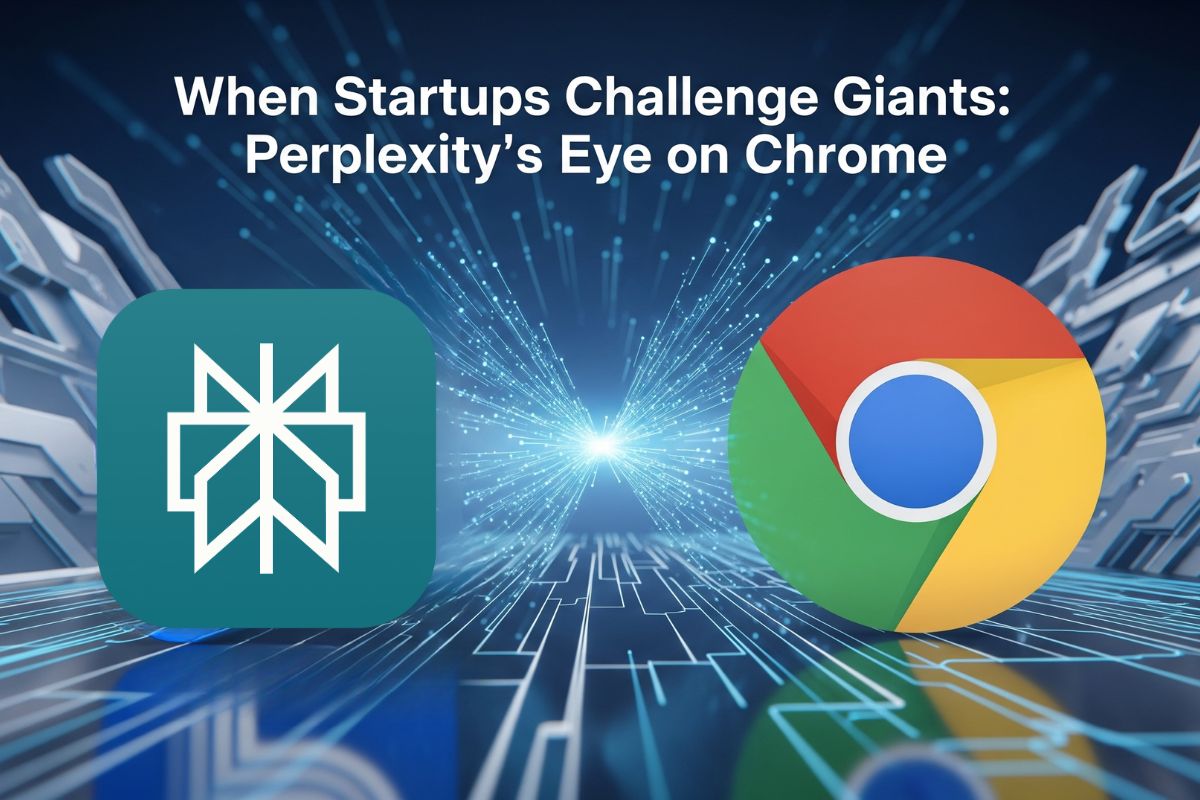
When Startups Challenge Giants: Perplexity’s Eye on Chrome
Madhurima Bhattacharjee
19th August 2025
Some stories in tech feel like a gust of wind. They stir the air for a moment, then pass. Others linger and echo. Perplexity’s offer to buy Google Chrome falls into that second category. Not because it will likely happen—it probably won’t—but because of what it says about ambition, attention, and the strange dance between giants and the bold upstarts who challenge them.
Chrome is not just a browser. It’s a front door to the modern web, used by billions. It’s the lens through which people search, shop, read, and learn. To aim for it is to aim for the crown. In the current AI-fueled environment where each and every tool struggles to be faster, more intuitive, and, in general, smarter, such a move seems ambitious and yet somehow rather natural.
The story is a case study if you ever wondered how smaller players rattle the cage in an industry that is a world of giants. Let’s look closely at the offer, the motives, the ripples it sends into Google’s world, and what it might mean for you, the person sitting behind the screen.
The Bold Offer: A Marketing Moonshot
What’s going on: Perplexity—an AI startup valued at about $18 billion—stepped into the spotlight with a $34.5 billion all-cash offer for Chrome. That’s nearly twice its own worth. Numbers aside, the gesture is pure theater. It’s not unlike walking onto a chessboard mid-game and placing your king in the center just to see what happens.
Why it matters: This isn’t just a bid for a product. It’s a bid for attention. A way of telling the world, we are here, and we are not afraid of big moves. In the noise of AI headlines, making people stop and look is a form of currency. Google, faced with antitrust scrutiny now, is suddenly being challenged, not so much with regard to acquisition flexibility, but to story.
Practical takeaway: What you make, sell, or build in the current market is as important as the visibility. There can be a case when a loud declaration—real or symbolic—becomes the bridge between obscurity and recognition.
What It Means for Google: Pressure and Perception
What’s going on: Google is fighting a major antitrust ruling, accused of monopolizing search. One remedy regulators might consider? Forcing it to sell Chrome. Perplexity’s offer slides neatly into this legal drama. It gives regulators a hypothetical buyer, which makes the idea of breaking Chrome away from Google less far-fetched.
Why it matters: Even if the offer is never taken seriously, it turns the heat up. Perplexity has inserted itself into a conversation about market fairness, user choice, and competition. And Google—so used to leading the story—finds itself reacting.
Practical takeaway: Credible alternatives are potent whether it is in business or in personal projects. To the consumer, this may bring a wider range of search and browsing. In the case of Google, it is a reminder that even symbolic moves can influence perception.
The AI Market Heatmap: Browsers as Battlegrounds
What’s going on: The humble browser is no longer a neutral tool. It’s becoming an AI-powered gateway. Perplexity already has Comet, its own AI browser. Acquiring Chrome would instantly place it on billions of devices. The reach would be unprecedented.
Why it matters: The one who controls the entry point controls much of the journey. If Chrome is the main road into the city, owning it means your signs, your assistants, and your suggestions greet the traveler first. For AI companies, this is the most valuable real estate there is.
Practical takeaway: To developers, it speaks of the increasing significance of platforms integrating human-friendly modes and profound intelligence. To you, as a user, it heralds an impending future in which your browser understands you, not only as a series of clicks, but as a series of likes, habits, needs, and predilections.
Perplexity’s Strategy: Credibility Meets Flair
What’s going on: Perplexity isn’t presenting itself as a reckless buyer. The offer comes with promises—keep Chromium open-source, keep Google as the default search engine (but give users a choice), and invest $3 billion in development. It’s a way of saying, we will care for this tool if it’s ours.
Why it matters: Those terms signal a willingness to maintain stability. It’s not about tearing the house down. It’s about moving in with a plan to add light, open the windows, and maybe build a garden out back.
Practical takeaway: Whether you’re pitching an idea or introducing change, reassurance can be as powerful as innovation. Users want to know that new doesn’t mean broken. Openness—like keeping Chromium free to the public—is often a trust builder.
Reality Check: A PR Stunt or Real Deal?
What’s going on: Many analysts think the bid is theater. Perplexity has raised around $1–1.5 billion—nowhere near what’s needed to buy Chrome. And Chrome is not for sale. The math alone makes the offer feel more like an attention grab than a serious transaction.
Why it matters: Yet even as a stunt, it works. It sparks debate. It forces people to imagine a different landscape. Sometimes the idea of a thing—whether or not it happens—can move the conversation forward.
Practical takeaway: There’s a lesson here about ambition. Dream high, but pair it with the resources and timing to make it real. As a user, don’t let the hype distract you from the reality—but also don’t ignore the way bold ideas can plant seeds for change.
Why Everyday Readers Should Care
What’s going on: This isn’t just tech gossip. This story touches on antitrust law, AI competition, user privacy, and the evolution of everyday tools. How you search, the results you get, the ads you see—these could shift depending on who owns and shapes Chrome.
Why it matters: Small changes at the level of browser ownership can ripple into how we work, shop, and even think about the web. AI will increasingly sit between you and the raw internet. Who controls that layer matters.
Practical takeaway: Stay alert to these shifts. You don’t need to read every legal filing, but understand that these decisions will shape the flow of information to you.
Next Steps: What to Watch for—and Try at Home
What’s going on: The antitrust case against Google continues. Regulators could demand structural changes. Perplexity’s Comet is already on the market, while Chrome remains the heavyweight champion. Competition in the browser space could intensify.
Why it matters: If the landscape changes—whether because of regulation, acquisition, or market momentum—you may see new features, AI assistants, and privacy tools emerge quickly. This is a space where sudden shifts can stick.
Practical takeaway – Try This:
- Test Comet or another AI-powered browser. Notice what feels intuitive, and what doesn’t.
- Compare search results in Chrome to an AI browser—see which better understands your intent.
- Keep an eye on this case. Even small developments could rewrite how the web greets you.
Conclusion
Perplexity’s attempt to buy Google Chrome may never pass from proposal to reality. But it has already done something important—it has reminded us that the future of technology isn’t just shaped by the companies that already own it. It’s also shaped by those willing to challenge them in public, with offers that feel impossible.
For you, the user, this is a moment to stay curious. To try new tools. To value companies that balance ambition with openness.
Sometimes, the big moves aren’t about the prize itself. They’re about shifting the conversation. In that sense, Perplexity has already bought something far more elusive than Chrome. It has brought our attention.
Views (6)
Comments (0)
Duration (0)




.jpeg)


 Facebook
 Instagram
 WhatsApp
 Linked in
 Twitter
 Reddit
Comments (0)
Write a Comment