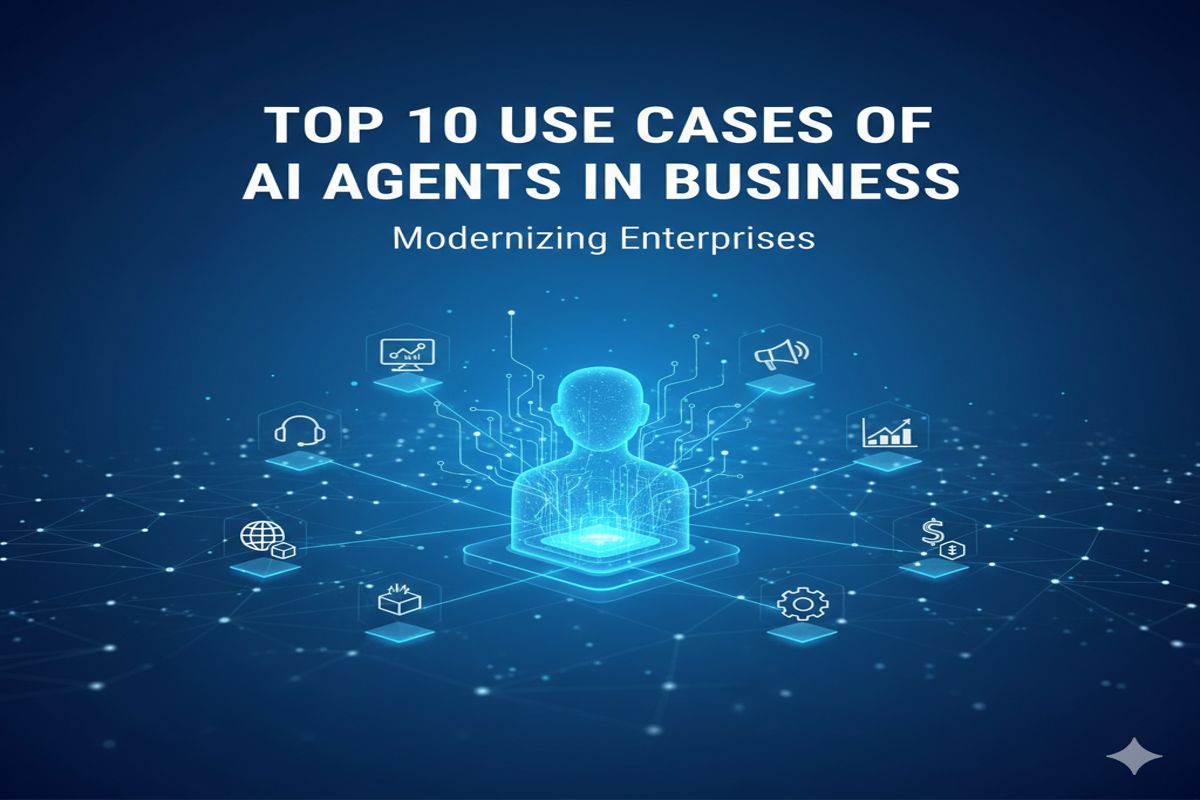
Top 10 Use Cases of AI Agents in Business
Madhurima Bhattacharjee
3rd October 2025
Patterns appear slowly when businesses adopt new technology. First curiosity rises with questions about potential benefits. Then hesitation builds with fear and uncertainty. Later adoption comes with practice and conviction. AI agents now stand beyond theory and imagination. They live inside real systems across industries today. They are not distant or futuristic anymore. They are present, they are active, they are shaping outcomes every single day. The question that matters now is simple. Where do AI agents help most, and what do they change in business life?
What Are AI Agents?
How are AI agents different from automation?
Automation stays fixed because it follows preset rules. AI agents move differently because they learn continuously. They read inputs, they adapt with context, and they respond with reason included. They are not basic machines or narrow tools. They bring logic into decisions that shape real action.
What types of AI agents exist today?
Four types stand clear when studied with care. Rule-based agents follow strict logic for fixed tasks. Conversational agents speak through text or voice to assist. Generative AI agents create words or designs from data. Autonomous task agents chain steps together for complex problem-solving. Each group holds a unique role inside business systems.
How are AI agents evolving with generative AI?
Generative AI has given agents new creative strength. They now draft reports or write code with ease. They design campaigns or summarize meetings with clarity. They move beyond helpers into partners for daily work.
Why Are Businesses Using AI Agents?
Can AI agents reduce costs and boost efficiency?
Yes, they can handle repetitive tasks efficiently. They reduce errors during critical and complex processes. They let workers focus on design and strategy.
Do AI agents improve personalisation and CX?
Customer experience rises when agents process wide data. They study customer behaviour across systems with precision. They respond with tailored offers at the right time. Customers feel understood, they feel valued, and they trust more.
How do AI agents enable better decision-making?
AI agents study large datasets in real time. They find patterns hidden in endless streams of information. Their insights guide quicker and sharper business decisions. Leaders act with confidence when signals feel clear.
What Are the Top 10 Business Use Cases of AI Agents?
1. How do AI agents transform customer support?
Customer support has always required speed and empathy. AI agents deliver across multiple active channels. They respond instantly, they resolve simple requests, & they forward complex issues when needed. This reduces waiting time and builds customer trust steadily.
Can virtual assistants handle 24/7 support?
Yes, they can remain active all hours. They stay online when staff must rest overnight. They handle chat, email, or voice without pause. Businesses gain a constant presence that customers expect daily.
2. How can AI agents improve sales and lead generation?
Sales depends on timing and context together. AI agents qualify leads through active data analysis. They reach out when customer interest feels strong. They maintain conversations when humans cannot stay engaged.
Can they qualify and nurture leads automatically?
Yes, they can manage leads automatically. They score leads, they schedule follow-ups, and they provide resources carefully. They nurture prospects until sales teams intervene directly. This builds faster and more accurate pipelines.
3. How are AI agents changing marketing automation?
Marketing once leaned on guesswork and wide targeting. AI agents now track customer actions at large scale. They optimise ads, they monitor responses, they refine campaigns deeply. They communicate with relevance across millions at once.
Can AI personalise campaigns at scale?
Yes, AI agents make campaigns more personal. They craft messages for each individual customer. They recommend products or services when demand is present. Scale and intimacy join in powerful new ways.
4. How do AI agents help HR and recruitment?
Hiring often demands rapid resume screening and sorting. AI agents shortlist candidates based on defined criteria. They reduce bias by relying only on patterns. They also assist with onboarding and employee support.
Can they screen resumes and onboard employees?
Yes, they can perform these tasks well. They check resumes, they send reminders, they answer common questions. They guide employees during onboarding with digital instructions. HR teams save time and focus elsewhere.
5. How are AI agents used in finance and accounting?
Finance requires precision, detail, and constant oversight. AI agents automate invoice checks and expense recording. They enforce compliance rules across transactions with consistency. They highlight anomalies that suggest possible fraudulent activity.
Do they help detect fraud and forecast finances?
Yes, they help in both tasks clearly. Agents analyze spending patterns for unusual movements in data. They issue alerts when signs look suspicious. They also forecast spending and revenue with accuracy.
6. How do AI agents optimise supply chain and logistics?
Supply chains move goods, services, and people globally. AI agents predict demand shifts using live signals. They plan routes and optimise storage in real time. They reduce waste when disruptions strike operations suddenly.
Can they predict demand and manage disruptions?
Yes, they can anticipate future demand precisely. They model scenarios and recommend safe options. They respond quickly than manual planning processes. Businesses sustain operations when shocks appear.
7. How are AI agents improving IT and security?
IT systems demand stability and constant protection daily. AI agents watch networks and data traffic continuously. They detect anomalies before failures spread further. They solve minor problems before humans even notice.
Can they detect anomalies and prevent cyber threats?
Yes, they can strengthen security effectively. Agents scan login attempts and system data streams. They block risky traffic immediately without delay. They escalate suspicious cases to security teams directly.
8. How do AI agents support product development and R&D?
Innovation requires deep research and wide exploration. AI agents review studies, patents, and reports rapidly. They find links across industries that humans may miss. They reveal gaps that suggest opportunity for creation.
Can they accelerate innovation cycles?
Yes, they shorten cycles significantly and clearly. They remove delays during research phases of projects. They propose initial drafts and test ideas. Teams move from concepts to products more quickly.
9. How do AI agents boost workplace productivity?
Modern work produces endless meetings and tasks. AI agents record minutes and summarise discussions. They assign action items inside shared project platforms. They prepare reports that once consumed many hours.
Can they automate meetings and task workflows?
Yes, they streamline workflows through automation. They design agendas before meetings take place. They track deadlines and follow up after meetings. They enable transparency and smooth cooperation across teams.
10. How are AI agents used in healthcare and compliance?
Healthcare must balance service with regulation carefully. AI agents assist patients with scheduling and reminders. They process claims and maintain compliance in systems. They reduce heavy workloads inside medical organisations.
Can they ensure regulations and patient engagement?
Yes, they ensure compliance and engagement. They maintain records for audits across requirements. They keep patient-provider communication steady and reliable. They reduce mistakes that harm care delivery.
What Future Trends Will Shape AI Agents?
Will multi-agent systems collaborate on tasks?
Yes, multiple agents will soon collaborate. Groups of agents will share work together. They will split roles and exchange outcomes. They will function as digital organisational teams.
How will AI agents integrate with IoT, robotics, and AR/VR?
AI agents will merge with connected machines globally. They will manage factories and direct smart devices. They will expand retail and training with AR. This merging will reshape industries deeply over time.
What ethical challenges do AI agents face?
Bias and fairness remain major challenges today. Transparency builds trust when outcomes affect lives. Accountability frameworks must guide deployments responsibly. Ethics must guide progress from the start.
What Challenges Should Businesses Consider?
Are data privacy and security at risk?
Yes, privacy and safety remain constant risks. Sensitive information demands strong defences with compliance. AI agents must follow strict encryption protocols. Without this, customer trust will collapse fast.
Is implementation costly?
Implementation requires money, skills, and careful planning. Smaller firms may struggle with early costs. Over time, efficiency outweighs the initial expenses. ROI becomes visible once systems stabilise.
Do AI agents still need human oversight?
Yes, oversight remains essential and non-negotiable. Human judgment ensures balance in decisions. AI can support but cannot replace responsibility. Machines and humans must work in balance.
Conclusion
What are the key takeaways from these 10 use cases?
AI agents have become active inside business processes. They support customer service, finance, and supply chains. They save money, they expand personalization, they sharpen insights. They are no longer optional business tools. They are vital competitive requirements today.
How can businesses start adopting AI agents today?
Adoption begins small with pilot implementations first. A chatbot or HR tool may start adoption. Businesses then measure results and adjust growth. Early adopters gain strength while others delay. Those who move soon will lead tomorrow.
Views (4)
Comments (0)
Duration (0)



.jpeg)


 Facebook
 Instagram
 WhatsApp
 Linked in
 Twitter
 Reddit
Comments (0)
Write a Comment