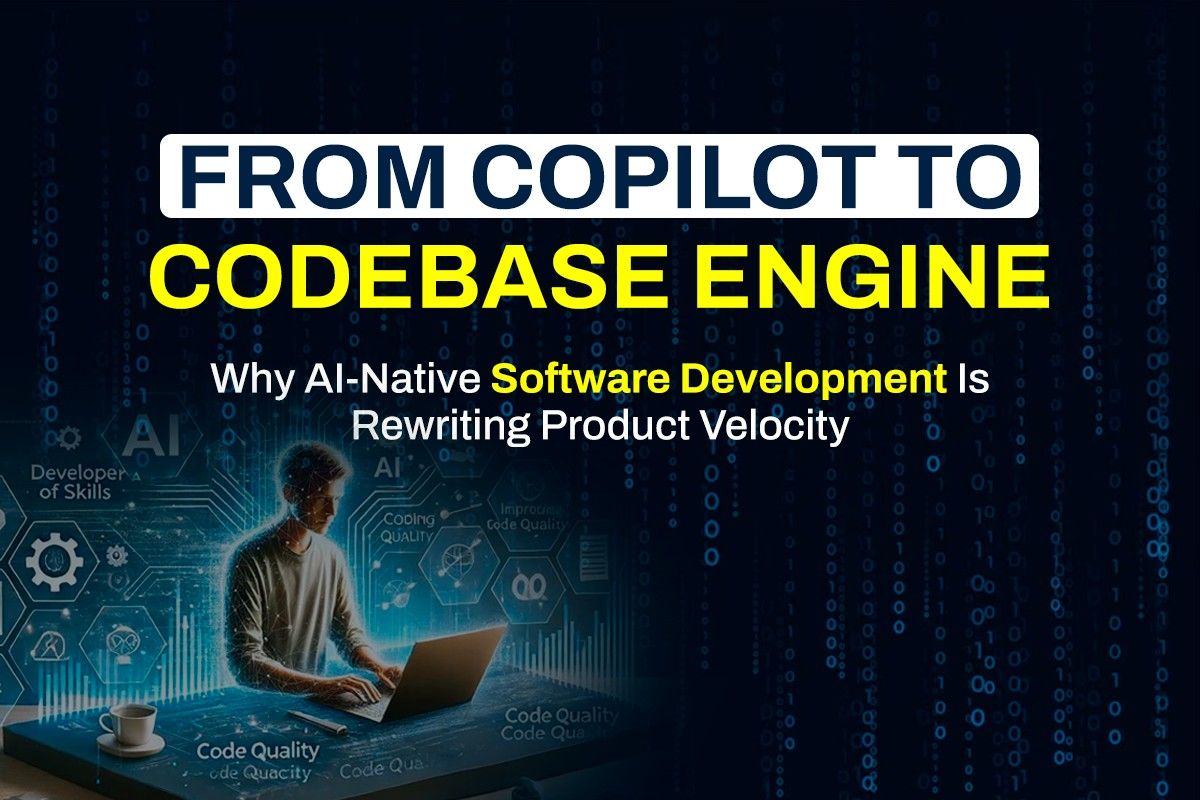
From Copilot to Codebase Engine: Why AI-Native Software Development Is Rewriting Product Velocity
Souvik Karmakar
21st May 2026
The End of Manual-First Development
Software teams used to treat AI like a coding shortcut. It could suggest a function. It could clean up syntax. It could help with documentation. That phase is ending fast. We are now entering the era of AI-native software development, where systems do far more than assist developers. They are beginning to plan logic, write modules, test outputs, and maintain momentum across the build cycle. AI is no longer sitting beside the engineer. It is moving into the workflow itself.
How the New Development Loop Works
This shift is not about faster autocomplete. It is about software creation becoming intent-driven. Modern teams are starting with product goals and letting AI systems translate those goals into execution paths.
Here is how the loop increasingly works:
- The Interpreter: The system reads product intent and turns broad ideas into technical tasks.
- The Builder: It generates functions, updates components, and refactors code across environments.
- The Validator: It tests outputs, catches issues, and supports autonomous software maintenance before problems reach users.
That is why intent-driven coding matters so much. It compresses the space between idea and implementation.
Why Product Teams Should Pay Attention
Traditional development creates friction at every handoff. Planning takes time. Writing takes time. Testing takes time. Fixing takes even more time. But AI-native software development reduces those gaps by keeping the cycle continuous.
Features can be scoped faster. Bugs can be detected earlier. Iterations can happen more often. This does not remove engineers. It removes drag. The real advantage is not just speed. It is sustained delivery without the usual operational fatigue.
What This Means for Builders and Agencies
The impact is bigger than engineering alone.
- For product managers: Roadmaps can move faster from concept to release.
- For developers: More time can go toward architecture, judgment, and edge-case thinking.
- For agencies and studios: Client builds can become leaner when intent-driven coding reduces repetitive execution.
As autonomous software maintenance becomes more reliable, teams will spend less energy patching the obvious and more energy building what actually matters.
Prepare for the Next Development Baseline
The market will not reward teams for writing every line manually. It will reward teams that ship better products with less waste. That is the real promise of AI-native software development. It is not magic. It is operational compression. Teams that learn this early will build faster, test smarter, and improve continuously. Soon, that will not feel innovative. It will feel normal.
Disclaimer
This blog is intended for informational and educational purposes only. The perspectives shared on AI-native software development, intent-driven coding, and autonomous software maintenance are based on current industry trends, evolving technologies, and emerging workflow practices. As AI development tools continue to rapidly advance, actual implementation results, capabilities, and long-term impact may vary across teams, platforms, and industries. Readers should evaluate these technologies based on their own technical, operational, and business requirements before making development or product decisions.
Views (97)
Comments (0)
Duration (0)

.jpeg)


 Facebook
 Instagram
 WhatsApp
 Linked in
 Twitter
 Reddit
Comments (0)
Write a Comment