NativePHP Launch: Build Real iOS, Android, and Desktop Apps Using Laravel
Souvik Karmakar
24th February 2026
Are You Still Believing That PHP Is Only For Building Web Servers?
If you have ever wanted to build a mobile or desktop app but dreaded learning Swift or Kotlin, you are not alone. Millions of developers hit the same wall. Traditional app creation forces you to learn entirely new languages, wrestle with Xcode and Android Studio, and master completely foreign ecosystems. That bottleneck kills product launches and burns budgets.
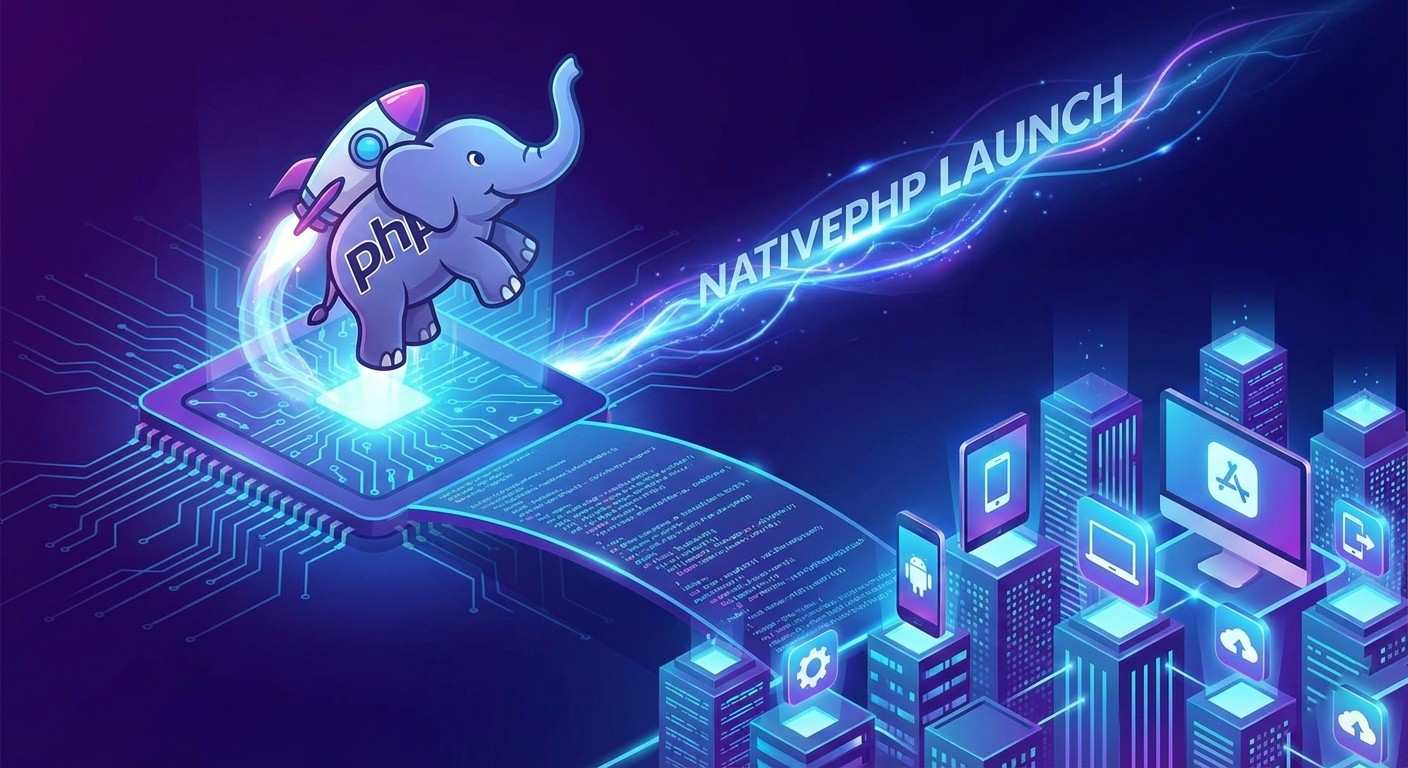
Picture a client asking for a native iOS application. A standard PHP developer would either outsource the whole project or start learning a new stack from scratch. The NativePHP launch removes that problem entirely. It lets you use your existing Laravel skills to build real native applications. It bundles a compiled PHP runtime into the application shell, and your code talks directly to native device APIs — no remote web server, no external hosting required. This is how PHP in app development is rewriting what PHP developers can deliver.
What Exactly Is NativePHP And How Does It Work?
NativePHP is a framework that brings server-side PHP code to user devices. It is not a browser wrapper. It is real, device-level execution — and the architecture is different depending on the platform.
- For mobile: It compiles a static PHP runtime and embeds it inside a Swift shell (iOS) or a Kotlin shell (Android). Your PHP code runs directly on the device hardware with zero remote server involvement.
- For desktop: It bridges your Laravel backend to an Electron window through a locally bundled PHP process. No external hosting, no remote server — everything runs entirely on the user's machine.
- A custom PHP extension forms the bridge between PHP and native OS functions. Your application renders inside a native web view, so the UI stays entirely within familiar PHP/Blade territory.
Think of a traditional web app as a vending machine that constantly needs a connection to a backend warehouse. The NativePHP launch turns that into a fully stocked, self-contained worker installed directly on the device. It taps into native tools like cameras, local databases, and secure storage. It makes your software capable of running completely offline. That is the true power of PHP in app development taken to a native level.
Why Does Open Source NativePHP Matter So Much Right Now?
This is not just a technical upgrade — it is a strategic one. Your existing server-side knowledge becomes a full mobile and desktop toolkit overnight.
How it helps your users:
- Users no longer need constant internet access to use your PHP-powered tools. Digital friction disappears.
- NativePHP for Mobile is now fully free and open source under the MIT license, meaning the community can build, contribute to, and optimize the core mobile architecture without any cost barrier.
Real-world importance:
- Development costs drop sharply. Your existing web developers can build mobile apps without onboarding a native team.
- Client satisfaction climbs naturally when PHP in-app development cuts project timelines by months.
Industry impact:
- For PHP-first teams, this rewrites the rules of software scaling. Companies no longer need to hire separate teams for iOS, Android, and web.
- The NativePHP launch multiplies output while keeping overhead costs low.
How Does The NativePHP Architecture Actually Work?
Here is exactly how the framework processes your code on a device, broken into four clear stages.
Step 1 — Context Gathering: When the app launches, the bundled runtime initializes your application. A custom PHP extension bridges PHP to native device languages. The NativePHP launch ensures your Laravel code can communicate with the operating system through clean, well-defined PHP interfaces right from the start.
Step 2 — Task Breakdown: These apps never reach out to remote servers. PHP in app development breaks your goals into local, bite-sized actions. Laravel's routing and controller logic maps a logical sequence that executes processes directly on the device CPU.
Step 3 — Tool Execution: The framework connects to local device APIs through native bridges. It can pull biometric data, run SQLite operations, and trigger native push notifications simultaneously. Open source NativePHP exposes dedicated PHP facades — Camera(), Biometrics(), PushNotifications(), SecureStorage(), and Geolocation() — so you never write a single line of Swift or Kotlin to access these features.
Step 4 — Iteration and Memory: Applications persist local state through embedded SQLite databases. If the internet drops, your app does not break. The offline logic keeps executing using locally stored data, and syncing resumes the moment connectivity is restored.
What Are The Key Features Of PHP In App Development?
Running natively without remote servers is possible because of three core strengths.
Real-Time Native APIs: The NativePHP launch gives your PHP code direct access to the camera, microphone, biometric sensors, and secure keychain. No Swift, no Kotlin, no third-party bridge libraries.
Deep System Integration: Your app reads and writes data across local filesystems and embedded SQLite databases seamlessly. This makes open source NativePHP a powerhouse for building offline-first applications.
Stateful Local Memory: Every user interaction is stored through embedded SQLite. This ensures apps built with PHP in app development feel fast and responsive at all times — with or without a network connection.
Who Needs To Leverage The NativePHP Launch?
This architecture is rapidly becoming the smart standard across the entire developer spectrum.
- Beginners: Growing startups use the NativePHP launch to deploy desktop and mobile apps fast. They skip hiring a mobile engineering team and build entirely on their existing web skills.
- Professionals: Freelancers expand their service offerings with open source NativePHP. They use PHP in app development to sell mobile and desktop versions of their existing web platforms.
- Businesses: Enterprise teams build secure internal tooling with this framework. The NativePHP launch lets them distribute offline-capable HR and administrative apps without maintaining separate native development teams.
- Innovators: Forward-thinking technology integrators deploy cross-platform systems using PHP in app development to build scalable, custom operations that directly boost client profitability.
What Are Some Practical Examples Of Open Source NativePHP?
Understanding the real-world ROI makes the decision easy. Here are three concrete scenarios.
Example 1 — Proactive Local Utilities: A user downloads a menu bar app for their Mac. That app uses open-source NativePHP to manage local scheduled tasks. It builds a custom SQLite database and a native UI, handling everything offline without a single remote server call.
Example 2 — Instant Mobile Commerce: A retail brand compiles its Laravel store into an Android app. PHP in app development caches products locally on the device. When the device goes offline, shopping continues seamlessly — and carts sync the moment the connection returns.
Example 3 — Streamlined Internal Tools: A product lead needs a secure desktop dashboard for the company. The NativePHP launch lets a solo web developer write the backend in Laravel and deliver a fully compiled Windows application in a fraction of the time a traditional native build would require.
What Are The Limitations Of PHP In App Development?
This technology is powerful — but it has real guardrails you need to understand before you ship.
Where it struggles:
- Bundling a PHP runtime into every app increases the initial download size compared to a lean native build. NativePHP v1.1 addressed this aggressively — iOS bundle sizes dropped from 55MB to 22MB, and Android bundles shrank by over 50% — but size is still a consideration worth planning for.
Performance risks:
- Running complex server-side logic locally can drain battery faster than a purpose-built native app. Code optimization is not optional when using open source NativePHP for CPU-intensive tasks. If genuine device efficiency is the top priority, heavy computational workloads need careful management.
Situations where it is not ideal:
- Do not use PHP in app development for high-end 3D gaming. When raw GPU access and intensive graphic rendering are required, a native game engine is the right choice — not a PHP-based framework.
What Will The Future Of Open Source NativePHP Look Like?
The move from remote servers to native devices is only the beginning.
What experts predict: The era of universal PHP codebases is approaching fast. Teams will use open source NativePHP to compile the same codebase for every major platform. One web developer will be able to ship to iOS, Android, macOS, and Windows simultaneously.
How the technology will evolve: The framework is heading toward becoming a native control center for PHP applications. You write standard Laravel code. The system automatically orchestrates all the necessary native bridges through the NativePHP launch, handling platform differences behind the scenes.
Why you should pay attention: Sticking to a web-only mindset is becoming a real competitive disadvantage. Competitors using PHP in app development will launch products significantly faster and at lower overhead. The window to get ahead of this curve is open right now — but it will not stay open indefinitely.
What Is The Final Takeaway For Your Application Strategy?
Building software three separate times for three separate platforms is not sustainable. Siloed development teams drain both budgets and time. The NativePHP launch gives your web team the power to conquer native platforms entirely on their own, executing complex desktop and mobile duties without any outside dependency. That eliminates operational bottlenecks and dramatically speeds up production cycles — freeing your talent to focus on strategy, not syntax.
Battery optimization is a real responsibility when running PHP in app development on mobile devices, but that is a manageable engineering discipline, not a dealbreaker. The move toward open source NativePHP is fast becoming the smartest strategic baseline for any PHP-first team in modern tech. Modernize your infrastructure, add true cross-platform capability to your daily operations, and start exploring the framework today to scale faster.
Disclaimer: This blog is for general informational purposes only. Features, performance, licensing, and release details may change over time, so always verify with official NativePHP and platform documentation before building or shipping. No guarantees or warranties are expressed or implied, and any examples mentioned are illustrative only.
Views (10)
Comments (0)
Duration (0)



.jpeg)

 Facebook
 Instagram
 WhatsApp
 Linked in
 Twitter
 Reddit
Comments (0)
Write a Comment